


Osteochondrosis rarely develops in the thoracic spine - the intervertebral discs there are smaller and thinner than in the cervical or lumbar spine.The thoracic region is less mobile, the main load falls on the ribs and sternum.
Unlike cervical and lumbar osteochondrosis, the symptoms of thoracic osteochondrosis differ only in the localization of pain.The nature of the pain and its duration are similar.In case of prolapse in the thoracic region, the spinal cord is not affected.Read about this and more below.
Stages of pathology
Osteochondrosis generally progresses over time.Depending on the severity of the manifestation, the pathology is divided into 4 stages.
Preclinical
Minimal disturbances appear in the spine.A slight pain syndrome can be observed, the back muscles become tense.It is possible to develop thoracalgia – chest pain, but this is a rare phenomenon.
Discogenic radiculitis
There is a change in the structure of the intervertebral discs.Moderate pain may appear in the affected part of the spine.The patient is able to work.But his level of muscular endurance is decreasing.
Vascular-radicular
At this stage, the annulus fibrosus is completely destroyed.A herniated disc is formed and the process of deformation of the annulus fibrosus continues, which leads to its rupture.Then the nucleus pulposus prolapses into the space beneath the ligaments.A herniated disc forms.The process affects the tissues located near the disc, the functioning of blood vessels, muscles, nerves and ligaments is disrupted.The disease becomes chronic.
Change the shape of the bone structure
The vertebra hardens, its surface becomes ribbed and uneven.Muscles begin to contract spontaneously, resulting in limited mobility of the entire spine or a specific vertebra.The nerves that extend from the spinal cord are pinched.This leads to a deterioration of impulses from the brain to the tissues and organs of the body.
The mobility of the spine as a whole is preserved, but individual vertebrae become fragile and can easily collapse.If the disease is not treated, it progresses to the fourth stage.
Regeneration of intervertebral disc tissue and replacement with scar tissue
A damaged intervertebral disc is unable to properly perform its functions, leading to convergence of adjacent vertebral bodies.This leads to disorders of the intervertebral joints, called spondyloarthrosis.In this case, twisting or displacement of the vertebrae relative to neighboring vertebrae may occur.
The body activates its compensation mechanisms.To relieve the load on a damaged disc, the vertebra flattens and enlarges.Its surface area therefore increases.And the tissue of the annulus fibrosus, which has collapsed, can be replaced by bone.
Sometimes this reduces pain, but as the vertebrae grow, the openings in the spine become even narrower - the nerve is pinched.
Symptoms of the disease
Symptoms of thoracic osteochondrosis are often caused by the following factors:
- patient age;
- damage to the spine;
- stage of disease development;
- The patient's condition is remission or exacerbation of the disease.
Symptoms may also include:
- radiculopathy – painful damage to the nerve endings in the spinal cord;
- abdominal syndrome;
- cardiac syndrome, changes in the heart muscle - characterized by severe pain and not sensitive to the effects of nitroglycerin;
- pulmonary syndrome: congestion and hypoxia occur in the lungs;
- paresthesia - a feeling of “goosebumps” throughout the body;
- pain in the area of the compressed nerve;
- decreased sensitivity to temperature fluctuations and touch;
- disorders of the motor function of the spine.
The patient's body temperature does not increase.This serves as a sign that helps differentiate the pathology.
Degrees of illness
Lumbago
This is a sharp pain that runs through the entire body.This occurs when lifting heavy objects and other physical activities - the pain is similar to an electric shock.
From a morphological point of view, unexpected rupture of the intervertebral disc capsule occurs when the load is too high.Such a traumatic injury leads to irritation of the nerves - pain occurs.
The muscles are tense and this is clearly expressed.The lumbar lordosis is smoothed.In this way, the load is redistributed and the intervertebral disc is compressed even more, leading to swelling which increases the pain.
When the pathology is concentrated in the neck region, neck pain appears - it is manifested by pain when turning the head and palpating the neck muscles.During an exacerbation, cervicocranialgia is often observed, which is manifested by the fact that a person has a severe headache in the back of the head.You may experience tinnitus, dizziness, a feeling of spots in your eyes, and your teeth may hurt.
Dizziness
Appear as a result of narrowing of the spinal canal cavity.The intervertebral disc swells and compresses the blood vessels.The brain fails to obtain the required volume of blood.You may experience severe headaches, numbness in your arms, and painful shoulders.
Breathing becomes difficult, leading to insufficient oxygen reaching the brain.This leads to shooting pain in the heart region.
Intervertebral hernia
At this stage of development, the picture seems quite serious: the spinal canal and intervertebral cavities are significantly narrowed.As a result, a hernia may form - a dangerous defect.Often at this stage of the disease it is necessary to resort to surgical intervention.
The treatment of third degree osteochondrosis depends on root compression.It is possible to use the same techniques as for the second degree.However, when the pain does not disappear within fifteen days and symptoms of prolapse (prolapse of a vertebra) are present, surgical intervention is necessary.
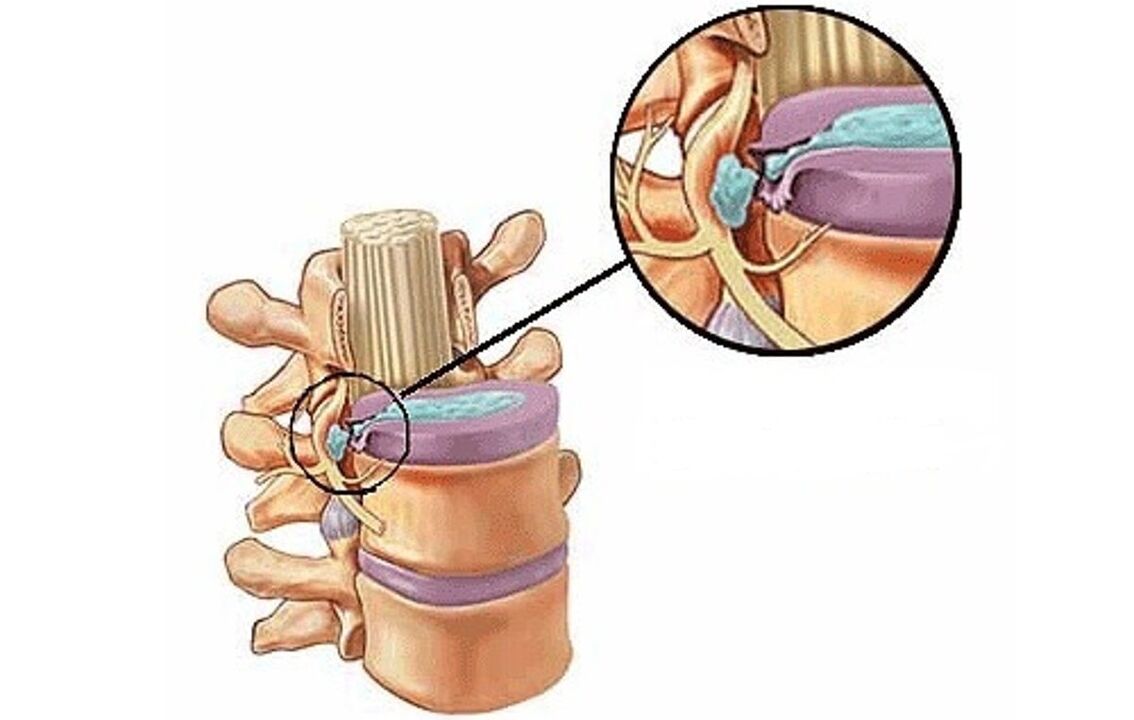
Growths on the vertebrae
As a rule, at this stage of the disease, the manifestations of the hernia disappear, the symptoms of the disease are less pronounced, however, it is noticed that the spine is unstable, the vertebrae can slip or twist relative to each other.
At this time, growth of vertebral bodies may occur – these are called osteophytes.The growths cause compression of the spinal nerves, which blocks the spinal canal, called secondary spinal stenosis.As a result, compression of the spinal cord is possible, which leads to ischemia.
This degree of illness also includes the consequences of previous operations aimed at removing a hernia.They can manifest as impaired innervation, paresis and inflammation.
Dorsago and back pain
Symptoms of thoracic osteochondrosis directly depend on the damaged area of the spine.The most common spinal syndromes are dorsago and back pain.
Dorsago manifests itself in the form of a sudden, sharp pain that occurs in the chest area.This often happens if a person sits for a long time without changing posture.Pain can occur when a person's position is physiologically uncomfortable.Moreover, this is possible during long-term monotonous work.
Dorsago is also called “thoracic lumbago”.When this happens, the muscles in your back and chest become so tight that it becomes difficult to breathe.
Sometimes the pain travels along the ribs to the sternum area and radiates to the shoulder blade area.Sometimes the patient may have the impression that it is a myocardial infarction.However, when performing an electrocardiogram, no deviations from the norm are detected.If you take nitroglycerin or another heart remedy, there will be no results.

Avoid staying in the same position for a long time.Sedentary work is one of the main causes of osteochondrosis.
Back pain is a mild pain that lasts a long time, sometimes up to several weeks.The inflamed area of the spine causes “mild” pain.This is uncomfortable, which is why the person usually comes to the doctor.
Back pain can be expressed as follows:
- the pain worsens when a person takes a deep breath or coughs;
- the muscles become overworked;
- motor activity in the neck or lower back decreases;
- muscle spasms occur;
- the pain intensifies at night and when a person exercises.
Back pain can be upper or lower.In the first case, the main painful manifestations are concentrated in the upper part of the chest, at the neck level.In the second case, the pain is mainly located in the sacrum and lumbar region.
The symptoms of back pain are very similar to the first manifestations of pneumonia.It is important to remember this in order to diagnose the disease in time.If the diagnosis is incorrect and treatment is prescribed, the patient's condition will only worsen.
When a woman is breastfeeding a child, she may experience such manifestations of osteochondrosis.It is necessary to treat the disease in this situation only by consulting a doctor, taking into account all the nuances.
It is important to weigh all the risks associated with the use of certain medications so as not to harm the baby's health and yours.
Atypical symptoms
In some cases, the symptoms of osteochondrosis of the thoracic spine are completely atypical.A person may not even be aware of the disease, since the symptoms are often similar to those of other conditions.They are worth considering in more detail and analyzing the situation as a whole:
- pain may appear, mimicking heart pain that develops during angina and heart attack;drugs for coronary dilation, for example nitroglycerin, have no effect;and the ECG shows no abnormalities;
- pain may occur in the same way as that experienced by women with breast diseases;such pain may persist for a long time;the examination reveals no problems with the mammary glands;
- the iliac region and abdomen may be painful, the symptoms are not similar to gastritis and colitis;pain can be observed under the right rib, similar to that which characterizes hepatitis or cholecystitis;Digestion is usually disturbed - this is also a characteristic symptom of osteochondrosis, due to disturbances in the innervation of internal organs;it is necessary to determine what caused the disorders in the process of digestion of food, whether the cause is really thoracic osteochondrosis;
- The process of urination and sexual function may be disrupted, since the innervation of the genitourinary system is distorted;
- when thoracic osteochondrosis worsens, pain in the sternum that lasts for weeks and long-term, very similar to that present in diseases of the mammary gland, can be observed;A visit to a mammologist helps identify the cause of the pain.
These symptoms are associated with manifestations of back pain, as well as intercostal neuralgia.The appearance of atypical symptoms is generally observed in the evening.In the morning, as a rule, there is no whiter.Pain increases throughout the day if appropriate conditions are created to cause pain.